


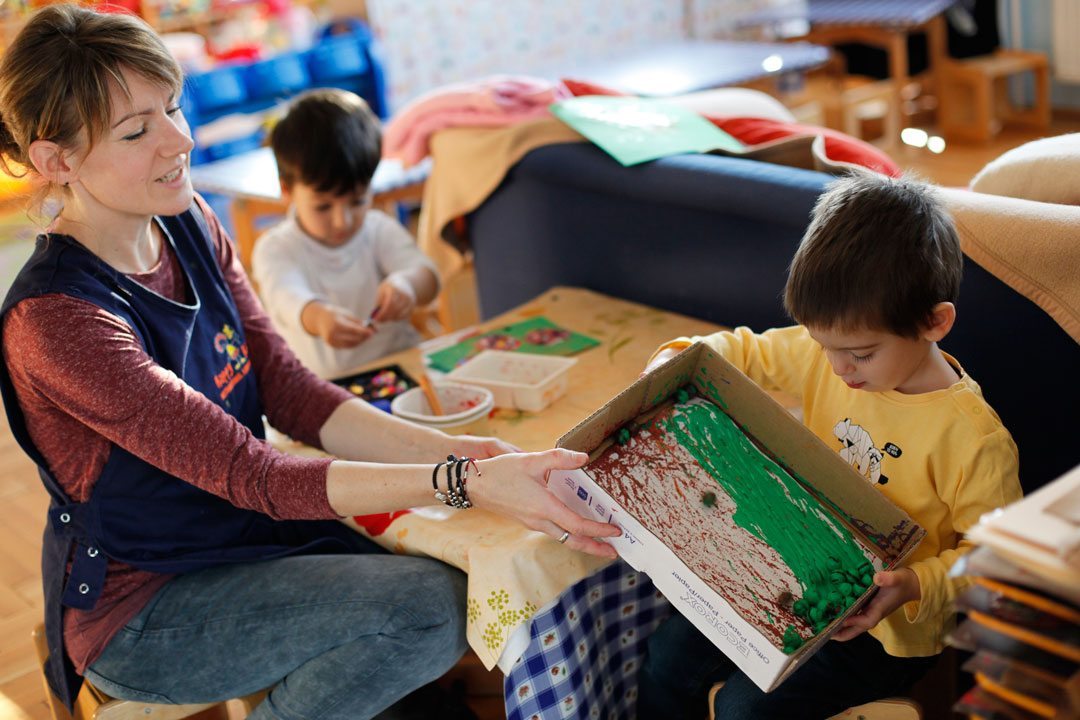
Our Educational Principles
We believe that a child who grows up in a calm, cheerful, loving and joyful atmosphere will become a happy, well-balanced, open-minded, helpful, active and creative schoolchild and adult who understands and respects others.
We consider a safe and secure environment to be of utmost importance, where adults devote their full attention to protecting and caring for young children in their everyday lives.
For us, every child is a unique and independent individual. Therefore, each child requires personalised care and differentiated development adapted to their own pace of progress. This principle is binding for every adult involved in their care and education.
The aim of our kindergarten and our educational approach is to educate children from international and multicultural backgrounds together within one institution, teaching them about harmonious coexistence, a sense of belonging, respect for and understanding of different cultures and customs, shared human values, and environmentally conscious living. The implementation of our principles is supported by plenty of play and physical activity, cooperation between parents and educators, and mutual respect among adults and children.
Our educational tasks, which support children’s development, prepare them for life in a community and help children from disadvantaged backgrounds to catch up, include:
- Applying the principles of gradual progression, continuity and playfulness in education;
- Taking individual abilities and age-specific characteristics into account in personalised development;
- Planning the proportion, content and methods of bilingual education;
- Creating a positive and encouraging environment that motivates children to communicate;
- Preparing children for school life throughout their years in kindergarten;
- Respecting and promoting respect for differences arising from diverse cultural and educational backgrounds within the international group of children.
We pay particular attention to the following areas:
- Educational activities related to child protection and safeguarding;
- Forms of cooperation between parents, children and kindergarten teachers, as well as opportunities for further developing this cooperation;
- In the case of kindergartens providing education for national or ethnic minority children, tasks related to preserving and promoting the culture and language of the minority community;
- The monitoring, assessment and evaluation of educational work carried out in the kindergarten, as well as its quality assurance system.