


The preschool years are a whirlwind of boundless energy and incredible curiosity. Yet, as a parent, finding engaging preschool activities that are both simple and truly beneficial can be a daily challenge. You might find yourself scrolling for inspiration, only to be met with ideas that require complex setups or a long list of supplies, leaving you wondering if you're providing the right opportunities for your child's growth and feeling pressured to spend thousands of forints on educational toys.
What if you could transform everyday moments at home into powerful, joyful learning experiences? We believe you can. This guide was created to empower you with a comprehensive collection of over 50 expert-approved activities that are delightfully simple and incredibly effective. Inside, you will discover how to use common household items to foster critical cognitive, physical, and social-emotional skills, turning playtime into a cornerstone of your child’s development.
Prepare to feel confident and inspired as you explore these fun-filled ideas, designed to not only prepare your little one for school but also to strengthen the precious bond you share. Let’s create an environment of excellence and joyful discovery, right in your own home.
Key Takeaways
- Understand how simple, at-home activities can build the fine and gross motor skills essential for your child's physical confidence and independence.
- Discover how playful learning can introduce foundational STEM concepts, nurturing your child's natural curiosity and problem-solving abilities from an early age.
- Learn the crucial role of sensory and creative play in brain development and how to foster social-emotional growth, helping your child build empathy and manage feelings.
- Access dozens of expert-approved preschool activities, categorized by developmental area, to make learning at home a joyful and enriching experience for your family.
Table of Contents
- Fine Motor Activities: Building Strength in Little Hands
- Gross Motor Activities: Getting the Wiggles Out with Purpose
- Cognitive & Early STEM Activities: Nurturing Curious Minds
- Creative Arts and Sensory Play: Unleashing Imagination
- Social-Emotional Learning Activities: Growing Kind Hearts
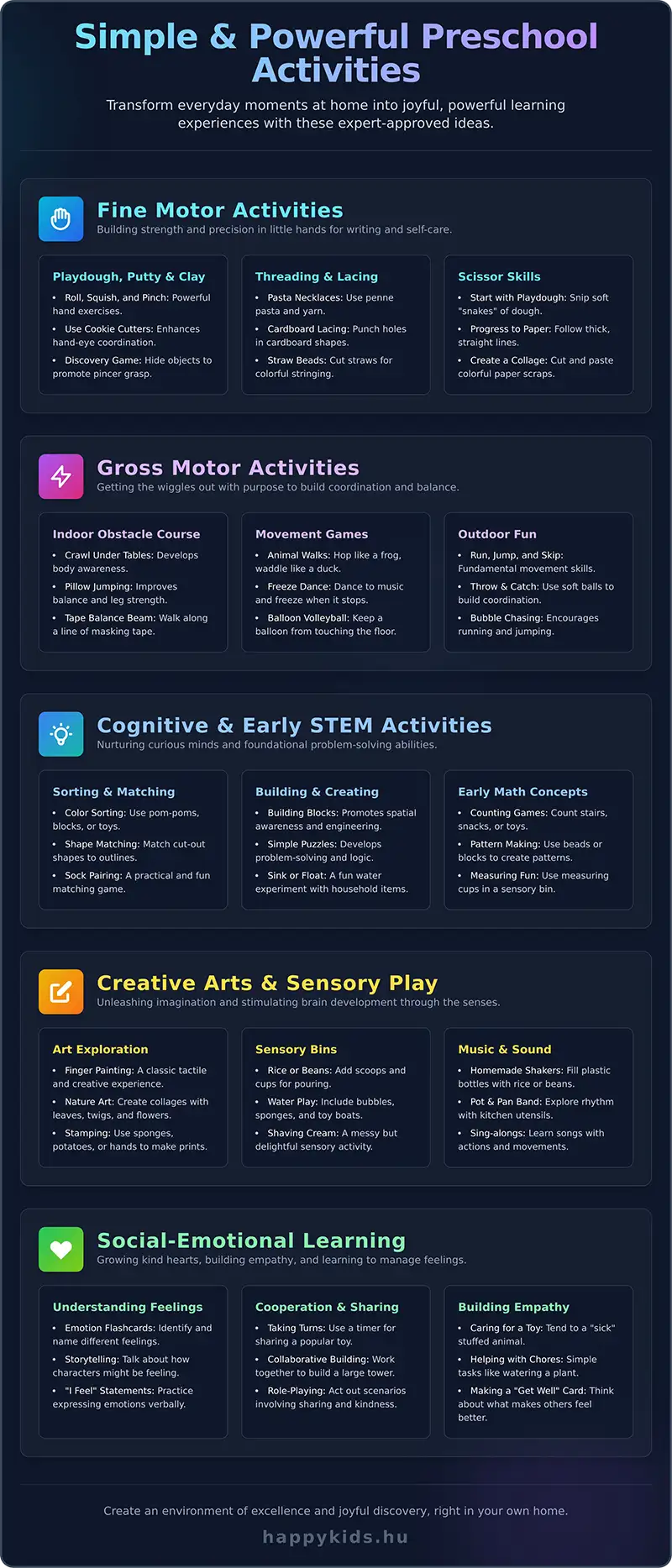
Fine Motor Activities: Building Strength in Little Hands
In the vibrant world of a preschooler, every small movement is a significant step towards independence. Fine motor skills-the precise, coordinated movements of the small muscles in the hands, wrists, and fingers-are the foundational building blocks for countless essential tasks. From the self-sufficiency of buttoning a coat and holding a spoon to the academic readiness required for holding a pencil and forming letters, strengthening these muscles is a critical part of early development. These skills are a cornerstone of early childhood development, a topic explored in depth in this Preschool education overview, and form the basis for future academic success. By engaging in simple, playful preschool activities at home, you can provide a joyful environment that nurtures this crucial growth.
Playdough, Putty, and Clay Fun
One of the most effective and enjoyable ways to build hand strength is through tactile play. Manipulating playdough, putty, or soft clay provides excellent resistance for little fingers. This playful work directly improves grip strength and dexterity, preparing children for tasks that require endurance, like writing.
- Roll, Squish, and Pinch: Encourage your child to roll dough into snakes, squish it into pancakes, and pinch off small pieces. These simple actions are powerful exercises for their hands.
- Use Cookie Cutters: Pressing cookie cutters into the dough requires downward pressure and control, enhancing hand-eye coordination.
- Discovery Game: Hide small, safe objects like large beads or plastic toys inside the dough for your child to find, promoting a refined pincer grasp.
Threading and Lacing Practice
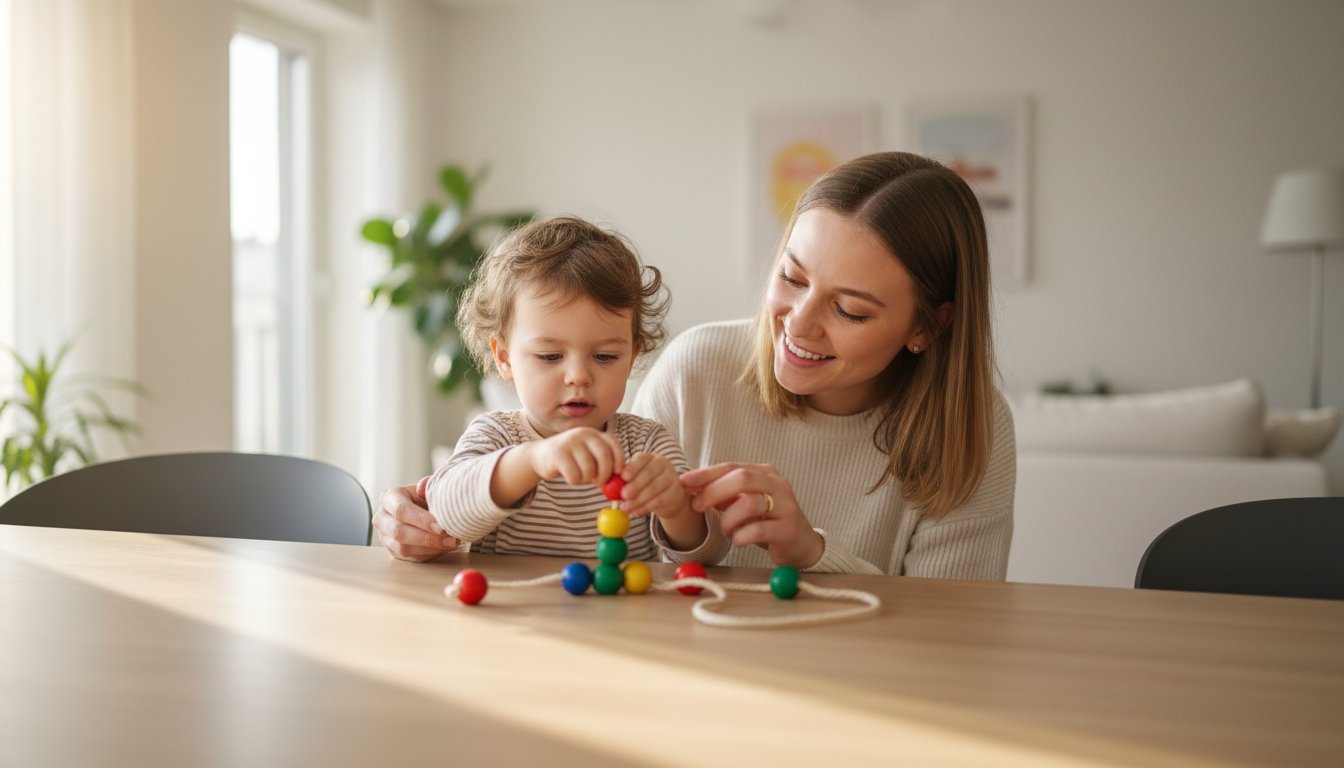
Threading and lacing activities are superb for developing hand-eye coordination, concentration, and the pincer grasp-the ability to hold an object between the thumb and forefinger. This skill is a direct precursor to holding a writing utensil correctly. These focused preschool activities also help improve bilateral coordination, as one hand must hold the object steady while the other threads.
- Pasta Necklaces: Use large, tube-shaped pasta like penne or rigatoni and a shoelace or piece of yarn for a simple and rewarding threading exercise.
- Cardboard Lacing: Punch holes around the edge of a sturdy piece of cardboard cut into a simple shape. Let your child lace yarn or a shoelace through the holes.
- Straw Beads: Cutting plastic straws into small pieces (an adult's job) creates colourful "beads" that are perfect for stringing onto yarn to make a bracelet or necklace.
Scissor Skills and Cutting
Learning to use scissors is a significant milestone that integrates hand strength, hand-eye coordination, and bilateral coordination. It is essential to introduce this skill with proper supervision and child-safe scissors. Start with materials that are easy to cut and progress slowly to build your child's confidence and control.
- Start with Playdough: The soft, thick texture of playdough is ideal for first attempts. Let your child snip rolled-out "snakes" of dough.
- Progress to Paper: Draw thick, straight lines on a piece of paper for your child to follow. As they gain confidence, you can introduce gentle curves and zig-zag lines.
- Create a Collage: Give your child colourful paper scraps, a glue stick, and a piece of paper. The goal isn't perfect shapes, but the joyful process of cutting and pasting to create art.
Gross Motor Activities: Getting the Wiggles Out with Purpose
For children aged 3 to 5, constant motion is a natural state of being. This boundless energy is not just restlessness; it is the engine driving crucial physical and cognitive growth. Engaging in gross motor activities-those that use the large muscles in the arms, legs, and torso-is fundamental for developing coordination, balance, and overall physical health. This active play is not just about burning energy; it's a cornerstone of healthy early childhood development, building foundational neural pathways for learning. Through running, jumping, and climbing, children develop body awareness and a deeper understanding of how their bodies move through space.
Purposeful physical play helps children build confidence and resilience. We've curated a selection of engaging preschool activities that can be adapted for any environment, ensuring children have ample opportunity to strengthen their growing bodies and minds.
Indoor Obstacle Courses
When the weather keeps us inside, a creative obstacle course can transform any room into an adventure zone. These activities are excellent for problem-solving and following multi-step directions. With a little imagination, everyday household items become tools for development:
- Crawl and Climb: Navigate a tunnel of chairs or crawl under a table, then climb over a mountain of soft pillows and cushions.
- Balance and Focus: Use masking tape on the floor to create straight or zig-zag lines to walk on like a balance beam.
- Jump and Land: Place hula hoops, boxes, or even pieces of paper on the floor for children to practice jumping in and out of, enhancing their coordination.
Outdoor Games and Exploration
The outdoors offers the ultimate sensory experience and limitless space for large-scale movement. Structured games and free exploration alike provide invaluable opportunities for physical and social learning. Here are some classic ways to encourage active play outside:
- Classic Movement Games: 'Simon Says' and 'Red Light, Green Light' are perfect for practicing listening skills, self-control, and rapid body movements.
- Ball Skills: Practice throwing, catching, and kicking a large, soft ball to develop hand-eye coordination and bilateral integration.
- Nature Walks: A simple walk around the garden or park becomes an adventure when children are encouraged to run, skip, and collect interesting leaves, stones, or sticks.
At Happy Kids, we believe these joyful outdoor experiences are essential. Our large, green playground is perfect for daily outdoor learning and discovery.
Cognitive & Early STEM Activities: Nurturing Curious Minds
The preschool years are a time of incredible curiosity, making it the perfect stage to introduce the foundational concepts of STEM (Science, Technology, Engineering, and Math). For young children, STEM is not about complex formulas or screens; it is about hands-on exploration, observation, and discovery through play. These engaging preschool activities are designed to nurture a child's innate desire to ask "why?" and "what if?", building a robust foundation for critical thinking and problem-solving. By encouraging them to question, experiment, and sort, we help them understand core concepts like cause and effect, patterns, and numbers in a joyful and intuitive way.
Simple Science Experiments
Turn your home into a mini-laboratory with experiments that are both safe and fascinating. These activities introduce the scientific method in its simplest form: making a prediction, testing it, and observing the outcome. It’s a wonderful way to demonstrate that science is all around us.
- Sink or Float: Fill a basin with water and gather various small toys and objects. Ask your child to guess which ones will sink and which will float before testing each one. This simple game introduces concepts of density and buoyancy.
- Primary Color Mixing: Using child-safe paint or food coloring in water, provide the three primary colors (red, yellow, blue) and let your child discover what happens when they mix them together.
- Planting a Bean: Place a bean in a clear jar with a damp paper towel. Let your child observe it daily as it sprouts, introducing them to the magic of life cycles and botany.
Early Math and Logic Games
Mathematics for a preschooler is about discovering relationships and patterns in the world. Everyday routines offer countless opportunities to build number sense and logical reasoning without pressure or formality. These games help make abstract concepts tangible and fun.
- Sorting and Classifying: Use a collection of buttons, toys, or even pasta shapes and encourage your child to sort them by different attributes like color, shape, or size. This builds essential classification skills.
- Everyday Counting: Count the steps as you walk up the stairs, the number of apple slices on their plate, or the red cars you see on a walk. This reinforces one-to-one correspondence.
- Pattern Creation: With LEGOs or colorful blocks, start a simple pattern (e.g., red, blue, red, blue) and ask your child what comes next. This introduces the concept of sequencing.
Building and Engineering Challenges
Nurture your child’s inner architect by providing simple materials and a challenge. These preschool activities are less about the final product and more about the process of planning, constructing, and learning from trial and error. They are excellent for developing spatial awareness, fine motor skills, and perseverance.
- The Tallest Tower: Using a set of wooden blocks or even empty cardboard boxes, challenge your child to build the tallest tower they can before it tumbles.
- Marshmallow and Toothpick Structures: This classic activity allows for the creation of 3D shapes, teaching children about stability and design in a delicious way.
- Build a Bridge: Set two books a short distance apart and challenge your child to build a bridge between them that can support a small toy car.
Creative Arts and Sensory Play: Unleashing Imagination
In the vibrant world of a preschooler, creative arts and sensory play are not just about making a mess; they are fundamental pillars of social and emotional development. These joyful explorations provide a powerful, non-verbal outlet for children to process their world, express complex feelings, and build self-confidence. At this age, the focus is on process art-celebrating the act of creation itself, rather than the final product. This approach fosters a safe space where there are no mistakes, only discoveries, empowering children to experiment and trust their own ideas.
Engaging the senses is equally critical for brain development. Sensory play builds neural pathways that are essential for more complex learning later on. When a child squishes play-doh or listens to the sound of rice pouring into a cup, they are conducting invaluable scientific experiments about the properties of their world. These hands-on preschool activities are foundational for cognitive and emotional growth.
Process-Focused Art Ideas
Encourage self-expression and fine motor skill development with art that has no "right" or "wrong" outcome. The goal is exploration and enjoyment. Here are a few simple yet effective ideas:
- Finger painting on a large sheet of paper: Allows for broad, expressive movements and direct sensory feedback.
- Painting with unusual tools: Introduce sponges, leaves, toy cars, or cotton balls to show that creativity has no limits.
- Collaborative drawing: Working together on a single large canvas or paper roll teaches children about sharing space, negotiation, and building on each other's ideas.
Sensory Bin Exploration
Sensory bins are versatile tools that can be tailored to engage multiple senses and support various learning objectives, from scooping and pouring to imaginative play. They provide a contained area for tactile exploration that is both calming and stimulating.
- Dry material bin: Fill a shallow tub with dry rice, pasta, or beans and add scoops, funnels, and small toys to encourage pouring and measuring.
- Water play station: A simple basin of water with bubbles, food colouring, and different-sized cups can provide hours of joyful learning about volume and cause-and-effect.
- Nature bin: Bring the outdoors in by creating a bin filled with soil, leaves, twigs, and smooth stones, allowing children to safely explore natural textures.
By providing these rich, playful opportunities, we give children the tools they need to understand themselves and connect with others in a meaningful way. These creative preschool activities build a strong foundation for a lifetime of curiosity and emotional intelligence.
Social-Emotional Learning Activities: Growing Kind Hearts
Social-Emotional Learning (SEL) is the essential process of helping children understand their feelings, connect with others, and build healthy relationships. In simple terms, it’s about learning to be a good friend-both to others and to oneself. For preschoolers, these skills are foundational. They empower a child to manage frustration, communicate their needs, share with peers, and develop empathy, which is the ability to understand how someone else is feeling. Mastering these abilities is a cornerstone of a positive and successful transition into school life.
Integrating purposeful, play-based preschool activities into your child's routine is a wonderful way to nurture this growth. These moments of connection and learning build the emotional intelligence that will support them for years to come.
Games for Turn-Taking and Sharing
Sharing and waiting are complex concepts for young children that require consistent and patient practice. The goal is to make cooperation a positive and rewarding experience. Structured games provide a safe and fun environment to learn these crucial social skills.
- Play simple board games or matching games. These activities have built-in rules for taking turns, teaching children patience and the joy of playing together toward a common goal.
- Build a shared tower. Using blocks, take turns adding one piece at a time to a single tower. This collaborative effort shows how teamwork can create something bigger and better than what one person could do alone.
- Use a timer for popular toys. A sand timer or kitchen timer can act as a neutral and fair guide, helping children understand that everyone will get a turn. It makes waiting predictable and manageable.
Exploring Feelings and Empathy
Before a child can manage their emotions, they must first be able to recognise and name them. Building this "feelings vocabulary" is the first step toward developing empathy and self-regulation. These creative exercises help make abstract emotions concrete and understandable.
- Create 'feeling faces' on paper plates. Draw simple happy, sad, angry, and surprised faces. Talk about what might make someone feel each emotion, helping your child connect the word to the feeling.
- Read stories and discuss the characters. Pause while reading and ask, "How do you think the rabbit feels right now? Why?" This encourages children to consider perspectives other than their own.
- Role-play with puppets or dolls. Use toys to act out common social scenarios, like asking to join a game or resolving a disagreement over a toy. This allows children to practice their responses in a low-pressure setting.
These skills form the bedrock of a compassionate and confident individual. In our multicultural classrooms, we practice these skills every single day, nurturing a community of kind and considerate learners in an environment of excellence.
Nurturing Lifelong Learners Through Joyful Play
As we've explored, the power of play is truly transformative in a child's early years. From strengthening fine motor skills with simple crafts to fostering critical thinking through early STEM challenges, these moments are more than just fun-they are the foundational blocks for cognitive, physical, and social-emotional growth. Integrating a diverse range of these preschool activities into your child's routine is one of the greatest gifts you can give, building a strong foundation for their future learning journey.
At Happy Kids International Kindergarten & Nursery, we are dedicated to creating an environment of excellence where this playful discovery is expertly guided. Our professional educators, representing a truly multicultural community, implement a curriculum meticulously designed to nurture all areas of development. In our extensive indoor and outdoor facilities, children are empowered to explore, create, and connect in a safe, caring, and stimulating setting. We provide the ideal space for your child to thrive and reach their full potential.
Discover how Happy Kids fosters development through play-based learning. Embrace these precious years and give your child a joyful start to a lifetime of success.
Frequently Asked Questions
What are the 5 main areas of development for preschoolers?
At this vibrant age, we focus on a child's holistic growth across five interconnected domains. These are: Cognitive Development (problem-solving, curiosity), Social and Emotional Development (empathy, self-regulation), Speech and Language (communication, listening), Fine Motor Skills (writing, buttoning), and Gross Motor Skills (running, jumping). A high-quality programme ensures that daily activities and play nurture each of these essential areas, creating a well-rounded foundation for future learning and well-being in our environment of excellence.
How can I entertain my 3 or 4-year-old without using screens?
Engaging a preschooler without screens is about sparking their natural creativity and curiosity. Simple activities like building forts with blankets, creating art with play-doh or paint, or engaging in imaginative role-play with dolls or costumes are wonderfully effective. Reading stories aloud together not only entertains but also builds crucial literacy skills. Outdoor exploration, even a simple walk in the garden to find different leaves and stones, provides rich sensory experiences that digital media cannot replicate.
What are some simple learning activities I can do at home with my child?
Learning at home can be seamlessly woven into your daily routine through playful interaction. Practice early maths by sorting laundry by colour or counting stairs as you climb them. Enhance language skills by asking open-ended questions about their day or a story you've read. Involving your child in simple cooking tasks introduces them to measuring and following instructions. These joyful, everyday preschool activities build foundational skills in a loving and familiar environment, turning ordinary moments into learning opportunities.
How do I know if an activity is right for my child's age?
The best indicator is your child's engagement. An age-appropriate activity should be challenging enough to be interesting but not so difficult that it causes frustration. Observe your child: are they curious and involved? Can they complete most of the task with minimal help? The goal is to find that sweet spot where they can build confidence and skills. Also, always prioritise safety, ensuring all materials are non-toxic and suitable for their handling abilities.
Should a 4-year-old be able to write their name yet?
Every child develops at their own unique pace, and there is a wide range for this milestone. While some four-year-olds can write their name, many are still developing the necessary fine motor skills. The focus at this age should be on pre-writing activities that strengthen hand muscles, such as drawing, scribbling, painting, and playing with clay. These foundational experiences are far more important for long-term writing success than mastering their name by a specific age.
How do play-based activities prepare a child for primary school?
Play is the essential work of childhood and the primary way children learn about their world. High-quality, play-based activities are fundamental to school readiness. When children build with blocks, they learn physics and problem-solving. During pretend play, they negotiate roles, develop complex language, and practice empathy. This joyful exploration cultivates critical thinking, social-emotional intelligence, and a love of learning-all essential prerequisites for success in a more structured primary school environment.