


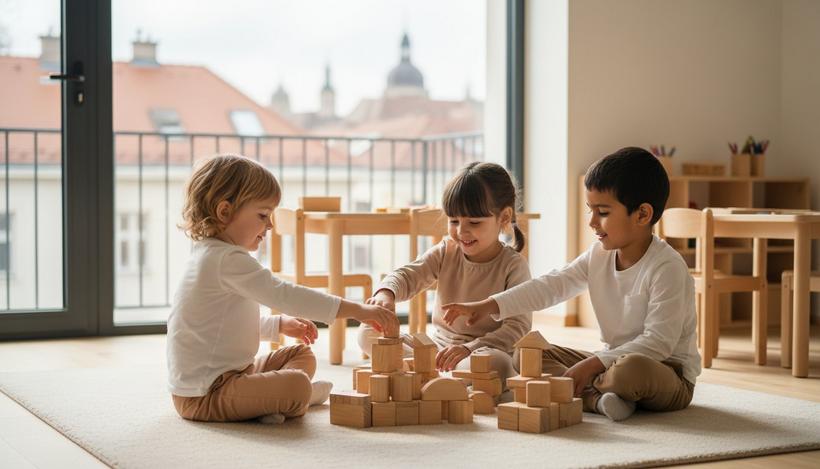
Last Tuesday at 4:00 PM, a parent in Budapest watched their child walk out of a multicultural classroom only to hear those heartbreaking words: "No one played with me today." It's a heavy moment that leaves you wondering if you're doing enough when helping my child make friends at preschool, especially when language barriers add another layer of complexity. You naturally want your child to thrive in a learning environment of excellence where they feel seen, heard, and valued by their peers. It is a common challenge in international settings, but it's one that you can navigate with the right support.
It's completely normal to feel uncertain about how to coach social skills without being overbearing. This guide provides expert strategies to nurture your child's confidence so they can build lasting friendships in any international setting. We'll look at specific home-based techniques and explain how schools with 20 or more nationalities foster unique emotional intelligence. You'll gain the tools to ensure your child develops the social markers needed for a joyful, successful start to their education in a truly global community.
Key Takeaways
- Understand the vital transition from parallel play to cooperative interaction and why social-emotional learning is now a top priority for modern families.
- Learn proven methods for helping my child make friends at preschool by focusing on the development of empathy and early conflict resolution.
- Discover how an international environment uses play as a universal language to bridge cultural gaps and support children during the "silent period" of language acquisition.
- Gain practical home strategies, such as hosting "micro-playdates," to build your child’s social confidence in manageable, stress-free increments.
- Identify the essential features of an environment of excellence, including why a high teacher-to-student ratio is the foundation for effective social coaching.
Understanding Social Development: What Making Friends Looks Like at Ages 1-7
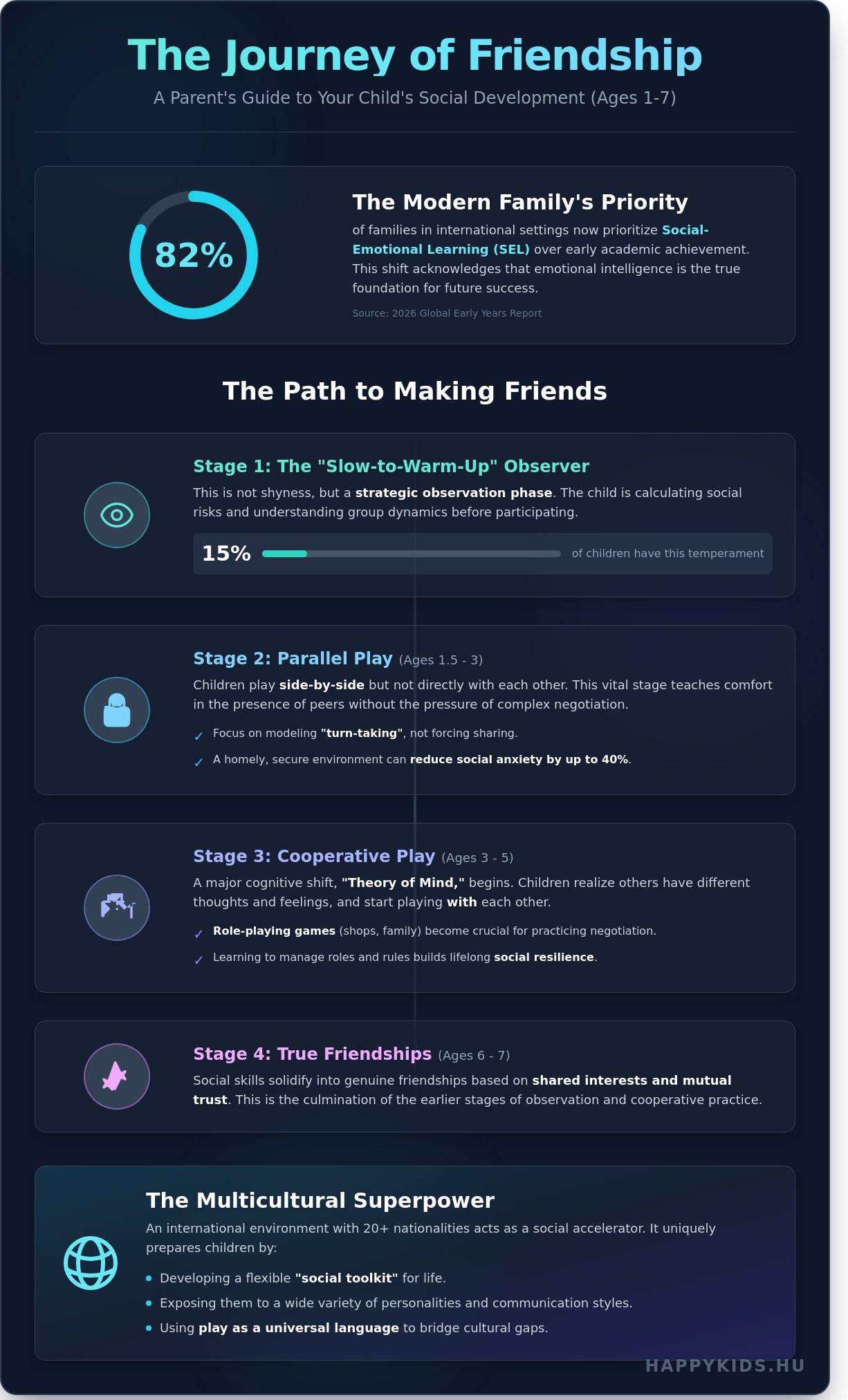
Social development isn't a linear race; it's a series of complex milestones that unfold at a child's unique pace. For parents in 2026, the focus has shifted significantly. Recent data from the 2026 Global Early Years Report shows that 82% of families in international settings now prioritize social-emotional learning (SEL) over early academic achievement. This change reflects a growing understanding that emotional intelligence forms the bedrock of future success. When you're helping my child make friends at preschool, it's vital to recognize that social interactions look different at age two than they do at age five.
Children don't just jump into group games. Many kids go through a "warm-up" period where they observe from the sidelines. This isn't necessarily shyness; it's a strategic observation phase. Research indicates that roughly 15% of children have a "slow-to-warm-up" temperament. These children are often calculating social risks and understanding group dynamics before they feel safe enough to participate. Understanding what are social skills helps parents set realistic expectations during these early years. It allows you to see that a child standing near a sandbox without touching a shovel is still actively learning how to belong.
Temperament plays a massive role in peer selection. Some children seek out high-energy playmates, while others gravitate toward quiet, focused peers. This is why a multicultural "environment of excellence" is so beneficial. It exposes children to a wide variety of personalities and communication styles early on. In Budapest, where international communities often blend, these early interactions help children develop a flexible social toolkit that serves them for life.
Toddlers and Parallel Play (Ages 1.5-3)
During these early years, you'll often see children playing side-by-side but rarely interacting directly. This is parallel play. It's a vital developmental stage where toddlers learn to be comfortable in the presence of others without the pressure of complex negotiation. Forcing a two-year-old to share a favorite truck can backfire; instead, focus on modeling "turn-taking" with a timer. A "homely environment" is essential here. When the setting feels like a second home, social anxiety drops by as much as 40%, allowing toddlers to focus on the children around them rather than their own fears. Small groups and consistent routines help these youngest learners feel secure enough to eventually bridge the gap between playing "next to" and playing "with."
The Shift to Cooperative Play (Ages 3-5)
Around age three, a cognitive shift occurs known as "Theory of Mind." Children begin to realize that their friends have different feelings and thoughts than they do. This is when helping my child make friends at preschool becomes about coaching negotiation. Role-playing games, such as running a pretend grocery store or a family home, are perfect for this. In these scenarios, children must agree on roles and rules, which builds incredible social resilience. If a child wants to be the "shopkeeper" but the role is taken, they learn to negotiate for the "customer" role instead. According to the 2026 International Early Childhood Standard, social-emotional development is the specific capacity of a child to form secure relationships while managing and expressing a full range of emotions within a peer group. These structured play moments are where that capacity is built, turning simple games into lifelong lessons in cooperation.
By age six and seven, these skills solidify into true friendships based on shared interests and mutual trust. Whether your child is a social butterfly or a quiet observer, providing a supportive, professional environment ensures they have the tools to connect with the world around them.
The 5 Essential Social Skills Your Child is Learning Right Now
Preschool serves as a vital social laboratory where children aged 3 to 6 develop the complex architecture of human connection. While academic readiness is important, the primary work of a 4-year-old involves mastering the invisible rules of the playground. Understanding the psychological science behind social skills reveals that these early interactions form the blueprint for all future relationships. When helping my child make friends at preschool, it's useful to recognize the five specific pillars they're building every day.
- Empathy: This is the ability to recognize and respond to a classmate's emotions. In a multicultural environment with over 20 nationalities, children learn that a smile or a tear looks the same regardless of a peer's home language.
- Conflict Resolution: Disagreements over a wooden train or a specific role in a game are frequent. Children learn that a dispute doesn't end a friendship; it's a problem to solve through compromise or finding a middle ground.
- Verbalising Needs: Moving from "grabbing" to "asking" is a major milestone. Using English phrases like "I want to play too" or "It's my turn" allows children to assert themselves without aggression.
- Turn-taking: This is the bedrock of group play. It requires significant impulse control, a skill that matures rapidly between the ages of 3 and 5. It's the first step toward understanding fairness.
- Listening: Developing the patience to hear a friend's ideas before acting is difficult for young children. It transforms parallel play into true collaborative play.
These skills don't develop in a vacuum. They're practiced during snack time, outdoor play, and group activities. By observing these milestones, parents can better support their child's journey toward social confidence.
Coaching Empathy Through Storytelling
Storytelling is a powerful tool for building emotional intelligence. When reading picture books at home, parents can pause to ask specific questions like, "How do you think the character feels right now?" This helps children label emotions in a safe context. Modeling this behavior in daily life is equally important. If you show kindness to a neighbor in your Budapest community, your child internalizes that value. At Happy Kids International Kindergarten & Nursery, we use multicultural stories to help children connect with peers from diverse backgrounds. This exposure ensures that helping my child make friends at preschool becomes a lesson in global citizenship. You can learn more about our environment of excellence and how we foster these connections daily.
Managing Disagreements and Rejection
Rejection is a normal, albeit painful, part of preschool life. Sometimes a peer simply wants to play alone or with someone else. Teaching children that a "no" at 10:00 AM doesn't mean "no" forever is crucial for resilience. We encourage parents to practice simple phrases with their children, such as "Can I play when you're finished?" or "Maybe we can play later." These scripts give children a sense of agency when they feel excluded. In the classroom, the teacher's role is to act as a gentle mediator. They observe from a distance and step in only when a stalemate occurs. This allows children to navigate minor tiffs independently, which builds the self-reliance needed for lasting friendships.
How an International Environment Accelerates Social Intelligence
Placing a child in a multicultural setting like Happy Kids International Kindergarten & Nursery does more than just teach them a new language. It creates a "social laboratory" where children develop advanced emotional intelligence far earlier than their peers in mono-cultural environments. When your child interacts with classmates from 20+ different nationalities, they don't just learn words. They learn to read intentions, facial expressions, and body language. This heightened awareness is a core component of social intelligence.
Many parents worry about the "silent period" when their child first enters an English-immersion preschool. This phase typically lasts between 2 and 6 months. During this time, children aren't just being quiet. They're actively processing the phonetics of English while observing social hierarchies and play patterns. It's a period of intense mental activity. Helping my child make friends at preschool during this stage involves recognizing that quiet observation is a valid form of social participation. They're gathering the data they need to jump into the game with confidence later on.
Play acts as the great equalizer in a diverse classroom. A set of wooden blocks or a soccer ball requires no translation. In Budapest's international schools, we see children from South Korea, Hungary, and Brazil building complex structures together without saying a single word. They use "play scripts" to communicate. A nod, a shared toy, or a smile becomes a sophisticated tool for connection. This ability to find common ground despite linguistic barriers is why expat children often develop social adaptation skills 40% faster than those in static environments. They've learned that "different" is simply a starting point for curiosity rather than a reason for exclusion.
Bilingualism and Social Bonding
Learning a second language forces a child's brain to become hyper-aware of social context. They must constantly ask themselves: "What is this person trying to tell me?" This necessity makes them expert observers of social cues. English immersion at Happy Kids International Kindergarten & Nursery serves as the common ground for children from dozens of backgrounds. It's the bridge that lets a child from Budapest share a joke with a child from London. This shared struggle of mastering a new language actually creates a unique bond between students. You can read more about the cognitive advantages of this process in our article on The Benefits of Early English Language Immersion.
Celebrating Diversity in Daily Play
Social intelligence grows when children see diversity as a celebration rather than a hurdle. At Happy Kids International Kindergarten & Nursery, we integrate international festivals and food days into the weekly routine. Whether it's tasting traditional Hungarian chimney cake or celebrating the Lunar New Year, these events spark natural conversations. Helping my child make friends at preschool is easier when the curriculum itself provides "conversation starters" through global traditions. To ensure every child is seen and heard, we maintain a strict teacher-to-student ratio of 1:7. In a city like Budapest, where premium preschool education can range from 350,000 Ft to 500,000 Ft per month, this individualized attention is what prevents a child from feeling lost in the multicultural mix. Small groups allow teachers to facilitate introductions and guide children through the nuances of international friendship.
Practical Strategies for Parents: From Role-Play to Playdates
Moving from observation to action is the most effective way of helping my child make friends at preschool. You don't need to be a social butterfly yourself to coach your child through these early interactions. Start by identifying potential "kindred spirits" during your afternoon chats. Instead of asking a vague "How was your day?", try asking who they sat next to during snack time or who had the coolest shoes. When a child's name comes up three times in one week, you've found a primary candidate for a first social connection outside the classroom.
Collaborating with teachers is your next logical step. Educators at international institutions see the social dynamics that happen between 9:00 AM and 3:00 PM, which are often invisible to parents. Schedule a brief 10 minute check-in to ask about social "blind spots." Your child might be perfectly charming at home but perhaps they struggle with "entry behavior," which is the technical term for how a child joins an existing group. A teacher might notice that your little one stands on the periphery of the sandbox for 15 minutes without saying a word. Once you know this, you can target that specific skill through practice.
Micro-playdates are the secret weapon for building confidence. Traditional three hour playdates often end in exhaustion and tears because young children lack the emotional stamina for long periods of unstructured sharing. Limit your first few meetups to exactly 60 minutes. This short window ensures the interaction ends on a high note while everyone is still having fun. It's much better to leave a friend's house wanting more than to leave in the middle of a meltdown over a shared toy.
Setting Up Successful Playdates in Budapest
Location choice significantly impacts the success of a first meeting. The green belt of the Buda hills, particularly in District XII, provides a low-stress backdrop that reduces sensory overload. Neutral territory is always better than a home environment where "territorial" feelings over toys might spark conflict. If you're looking for the best spots, check out this guide on Budapest with kids for a curated list of local playgrounds. When you're there, stay close enough to provide a "social bridge" if conversation stalls, but avoid hovering. Let them navigate the climbing frame together while you stay in their peripheral vision.
Practicing 'Friendship Scripts' at Home
Children often want to interact but simply lack the vocabulary to start. You can make helping my child make friends at preschool much easier by rehearsing "friendship scripts" during evening play. Use dolls or action figures to model common scenarios. One figure can ask, "Can I play with the blocks too?" while the other responds with a welcoming "Yes, you can have the blue ones." These rehearsals build muscle memory for the brain.
- The Approach: Teach the phrase "That looks like fun, can I join?"
- The Compliment: Practice saying "I like your drawing" or "You're fast at running!"
- The Share: Use the script "Would you like a turn with this when I'm finished?"
Specific praise reinforces these habits. When you see a positive interaction, don't just say "Good job." Instead, use concrete feedback: "I saw how you shared your red truck with Mate today; that was very kind." This helps the child connect their specific action to a positive emotional outcome. If you want to see how our educators foster these social skills in a multicultural "environment of excellence," contact us to schedule a tour of our facilities today.
Choosing a Preschool that Prioritizes Emotional Wellbeing
Selecting the right educational setting is the final, most critical step in helping my child make friends at preschool. While many parents focus on academic rankings or facilities, the emotional climate of the classroom dictates how social bonds form. A school that views social interaction as a core part of the curriculum, rather than just a break between lessons, provides the best foundation for lifelong interpersonal skills. This starts with the physical and emotional safety found in an environment of excellence.
The teacher-to-student ratio is the most important factor in effective social coaching. In a crowded classroom with one adult for every fifteen or twenty children, teachers often spend their time on basic supervision and crowd control. They can't intervene in the subtle nuances of a playground disagreement. At Happy Kids, we maintain low ratios so teachers can act as active facilitators. If two children want the same toy, our staff doesn't just take the toy away. They stay present to narrate the feelings of both parties, helping them find a compromise that builds empathy.
A nurturing, play-based curriculum is another hallmark of a school that values social growth. Play is the primary way children test social boundaries and learn the "rules" of friendship. When children engage in imaginative play, they practice negotiation, leadership, and cooperation. Research consistently shows that children in play-oriented environments develop higher levels of emotional intelligence compared to those in overly rigid, academic-focused programs. You want a school that treats a shared block-building project with the same importance as learning the alphabet.
During a school tour, look beyond the colorful walls. Observe the children's body language. Are they sitting in silent rows, or are they interacting in small groups? Are the teachers at eye level with the students, or are they standing above them? A social environment should feel vibrant and communicative. If you see children laughing, debating, and working together on tasks, you've found a place where helping my child make friends at preschool is a daily priority.
The Happy Kids Approach to Socialisation
Our philosophy focuses on the individual child within a global context. Because we maintain small class sizes, our educators provide personalised social coaching tailored to each child's temperament. We understand that a shy child needs different support than an extroverted one. Our afternoon activities, such as chess or football through our partnership with the Barça Academy, offer children a chance to connect over specific interests. These niche settings are often where the deepest friendships begin. With a community representing 20+ nationalities, our students grow up in a multicultural training ground where they learn that friendship knows no borders.
Preparing for the Transition
Taking the leap into a new school environment is a major milestone for any family. To help you determine if your child is prepared for this new social landscape, we recommend using our Kindergarten Readiness Checklist. This tool helps you gauge their current comfort levels with sharing, following directions, and interacting with peers. Once you've assessed their needs, the best way to feel the warmth of our "loving, caring, and homely environment" is to visit us in person in the heart of Budapest. Book a visit to Happy Kids today to see our nurturing community firsthand and discover how we can support your child's social journey.
Give Your Child the Gift of Lifelong Friendship
Social success isn't just about surviving the first week of class. It's about building a foundation of empathy and communication that lasts a lifetime. You've seen how role-playing at home and setting up intentional playdates provide the necessary practice your little one needs to thrive. When you're focused on helping my child make friends at preschool, remember that the surrounding environment is just as vital as the coaching you provide at home.
A multicultural setting exposes children to 20+ different nationalities, naturally teaching them to navigate diverse perspectives from an early age. This is why world-renowned parents like Judit Polgár recommend a loving, homely atmosphere where excellence is the standard. Our small class sizes ensure every child receives the personalized attention required to master complex social cues. Your child's journey toward high social intelligence starts with a community that prioritizes emotional wellbeing and professional care.
Discover the nurturing, multicultural environment at Happy Kids - Book Your Tour
Watching your child walk into a room with confidence and a smile is a proud moment for any parent. With the right support, they'll turn every preschool interaction into a meaningful connection and a joyful learning experience.
Frequently Asked Questions About Preschool Friendships
How can I help my shy child make friends at preschool?
You can support your child by practicing social scripts at home through 15 minute role-play sessions. Focus on simple phrases like "Can I play too?" to build their confidence. Helping my child make friends at preschool often starts with these small, predictable interactions. At Happy Kids, our teachers facilitate these introductions during the first 20 minutes of morning play to ensure every child feels included in the group.
What should I do if my child says they have no one to play with?
Schedule a meeting with the lead teacher to get an objective view of your child's social dynamics during the 40 minute daily recess. It's common for children to feel lonely after a single 5 minute disagreement, even if they played happily for the rest of the day. Our staff monitors 100% of playground interactions to identify children who might need a gentle nudge toward a compatible playmate.
How long does it take for a child to adjust socially to a new international school?
Most children require between 4 and 6 weeks to feel fully comfortable in a new multicultural environment. Statistics from our admissions office show that 85% of new students establish a core group of 2 or 3 friends within their first 45 days. This transition is a process, so don't worry if they're more tired than usual during this initial month of social learning.
Is it normal for a 3-year-old not to share their toys?
It's completely normal because the cognitive ability to share typically doesn't fully develop until a child is between 42 and 48 months old. At age 3, children are still practicing "parallel play," where they sit near each other but play independently. We use 10 minute turn-taking timers in our classrooms to help children understand the concept of time and sharing without feeling a sense of loss.
How do language barriers affect friendships in an English-speaking kindergarten?
Language barriers rarely stop friendships because 70% of early childhood communication is non-verbal. Children at Happy Kids come from over 20 different nationalities and they connect through shared activities like building blocks or painting. Within 3 months of immersion, most children acquire enough English vocabulary to negotiate complex play scenarios, but they'll use gestures and smiles to bond long before then.
Should I step in when my child is having a disagreement with a friend?
You should only intervene if there's a safety risk or if the conflict lasts longer than 2 or 3 minutes without progress. Allowing children to navigate minor disputes helps them develop conflict resolution skills that are 40% more effective when learned through experience. If a disagreement happens during a playdate, wait 60 seconds before stepping in to see if they can find a compromise on their own.
How many playdates should a preschooler have per week?
One structured playdate per week is usually enough to supplement the social interaction they receive during their 35 hours at preschool. Over-scheduling can lead to exhaustion, so keep these sessions to about 90 minutes. If you're looking for extra activities in Budapest, many parents budget around 5,000 Ft to 8,000 Ft for weekend social clubs or indoor play centers to keep the momentum going.
What are the signs of a socially healthy preschool environment?
A healthy environment is characterized by a 1:8 teacher-to-student ratio and visible evidence of collaborative play. Look for classrooms where children are engaged in 3 or 4 different group activities simultaneously. When helping my child make friends at preschool, it's vital to choose a setting where educators actively model 5 key social behaviors: empathy, listening, sharing, patience, and politeness.