


Choosing the right path for your child's first steps into learning can feel like navigating a complex map without a compass. With terms like 'Montessori' and 'play-based learning' at every turn, it's easy to feel overwhelmed, worrying if you're making the best decision for their future. This is where a clear understanding of early childhood education becomes your most valuable tool. This crucial stage is about far more than preparing for school; it’s about laying the foundation for a lifetime of curiosity, confidence, and connection in a loving, nurturing environment.
In this definitive guide, we are here to be your trusted partner on this journey. We will demystify the jargon, explore the profound, long-term benefits of a quality start, and provide you with a clear, practical checklist for evaluating potential nurseries and kindergartens. Our goal is to empower you with the confidence and knowledge to select an environment of excellence-a place where your child will not only learn but thrive in a joyful, caring, and stimulating community, feeling happy and secure from their very first day.
Key Takeaways
- Understand that high-quality early childhood education is more than just play; it's the foundational period that shapes your child's future learning and social-emotional skills.
- Discover the core educational philosophies, from Montessori to Reggio Emilia, to identify the approach that best aligns with your child's unique personality and your family's values.
- Learn how a balanced program nurtures the whole child, developing crucial skills in everything from cognitive problem-solving to creative expression and physical coordination.
- Utilize our expert checklist to confidently assess potential schools, focusing on key indicators of a safe, stimulating, and caring learning environment of excellence.
What is Early Childhood Education (And What It Isn't)?
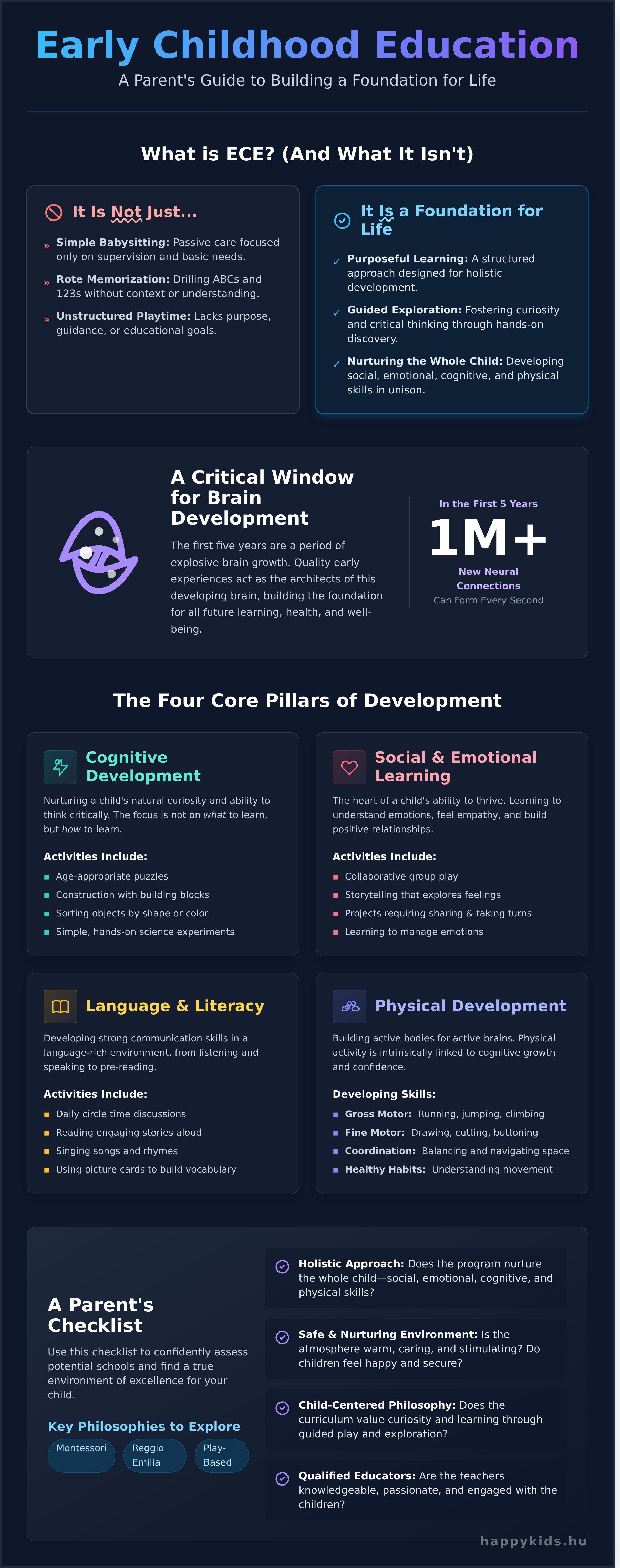
At its heart, early childhood education is the foundational stage of a lifelong journey of discovery and learning. It encompasses the crucial developmental period from birth through to around age seven, providing the essential building blocks for future academic and personal success. It's a common misunderstanding to equate it with simple babysitting or daycare. In reality, a high-quality programme is a purposeful and structured approach to learning, designed to support a child's overall development in a nurturing, professional environment.
This period is about much more than preparing for primary school; it is about preparing for life. For parents seeking a deeper understanding of the formal theories and practices behind what is Early Childhood Education, it's best understood as a comprehensive framework that fosters curiosity, confidence, and a love for learning that will last a lifetime.
Beyond ABCs: A Holistic Approach to Growth
True ECE moves far beyond the rote memorization of letters and numbers. It champions a holistic philosophy, nurturing a child's social, emotional, cognitive, and physical skills in unison. Learning happens organically through guided play, hands-on exploration, and joyful discovery. This approach cultivates curiosity and critical thinking, empowering children to become active participants in their own education rather than passive recipients of information.
The Science: How Early Experiences Shape the Brain
The first five years of life represent a critical window for brain development, where over a million new neural connections can form every second. Quality early learning experiences act as the architects of this developing brain. Every positive interaction and caring relationship helps build a strong neural framework. Think of it as constructing the foundation of a house: a robust, well-built foundation in early childhood supports all future learning, health, and well-being.
The Core Pillars: What Your Child Learns in an ECE Program
At first glance, a high-quality preschool environment looks like a world of joyful play. But behind every song, story, and shared toy is a thoughtfully designed curriculum built upon the core pillars of development. A premier early childhood education program doesn't treat these domains in isolation; it understands that cognitive growth is fuelled by social interaction, and physical confidence supports emotional well-being. This holistic approach ensures your child develops into a well-rounded, capable, and happy individual.
Cognitive Development: Building Curious Minds
This pillar focuses on nurturing a child's natural curiosity and ability to think critically. It’s not about memorizing facts, but about learning how to learn. We encourage children to ask "why," explore cause and effect, and find creative solutions. This builds the intellectual foundation for a lifetime of discovery.
- Activities include: Solving age-appropriate puzzles, constructing with building blocks, sorting objects by shape or colour, and engaging in simple, hands-on science experiments.
Social and Emotional Learning (SEL): The Foundation of Well-being
SEL is the heart of a child's ability to thrive. It involves learning to understand and manage emotions, feel empathy for others, and build positive relationships. These skills are critical, as research consistently shows they are a key predictor of future happiness and success. The importance of these foundational skills is widely recognized, with sources like the US Department of Education on ECE emphasizing their role in preparing children for school and life.
- Activities include: Collaborative group play, storytelling that explores different feelings, and projects that require sharing and taking turns.
Language and Literacy: From First Words to Storytelling
A language-rich environment is essential for developing strong communication skills. This pillar covers everything from listening and understanding to speaking clearly and developing pre-reading abilities. Through constant exposure to new words and ideas in a supportive setting, children build the vocabulary and confidence to express themselves.
- Activities include: Daily circle time discussions, reading engaging stories aloud, singing songs and rhymes, and using picture cards to identify objects.
Physical Development: Active Bodies for Active Brains
Physical activity is intrinsically linked to brain development. Our approach to early childhood education addresses both major areas of physical growth. Gross motor skills involve large muscle movements, while fine motor skills require precise control of smaller muscles. Developing these skills through joyful movement builds not just physical strength, but also self-confidence and body awareness.
- Gross Motor Skills: Running, jumping, and climbing in secure outdoor play areas.
- Fine Motor Skills: Drawing with crayons, using scissors safely, moulding clay, and threading beads.
Exploring ECE Philosophies: Which Approach is Right for Your Child?
Navigating the world of early childhood education can feel complex, with various philosophies shaping how children learn and grow. Understanding the core tenets of each approach is the first step in finding a nurturing environment that aligns with your child's unique personality. While methodologies differ, the highest quality programmes are all built upon a foundation of respect for the child, a commitment to safety, and best practices, many of which are reflected in the NAEYC quality standards. Let's demystify three of the most influential models.
Play-Based Learning: Where Joy and Discovery Intersect
This philosophy is centered on the profound idea that play is a child's most important work. In a play-based classroom, learning is not separated from fun; it is embedded within it. The environment is typically organized into dynamic "learning centers"-such as a construction zone with blocks for exploring physics, a dramatic play area for social skills, and a creative arts station for self-expression. Through guided and unstructured play, children develop crucial problem-solving skills, emotional intelligence, and a lifelong love for learning.
Best for: Social, energetic, and curious children who thrive on collaboration and hands-on discovery in a vibrant setting.
Montessori: Fostering Independence and Self-Direction
Developed by Dr. Maria Montessori, this approach is founded on deep respect for a child's innate desire to learn. The classroom is a calm, orderly, and "prepared environment" where everything has its place. Children engage with meticulously designed, self-correcting materials that invite exploration. The focus is on individualised, uninterrupted work cycles, allowing each child to progress at their own pace and cultivate deep concentration. Teachers act as guides, observing and introducing new challenges when a child is ready.
Best for: Independent children who enjoy structure, work well at their own pace, and find satisfaction in mastering tasks.
Reggio Emilia: The Child as a Co-Creator of Knowledge
Originating in Reggio Emilia, Italy, this philosophy views the child as a competent and capable protagonist in their own learning journey. It features an "emergent curriculum" where long-term, in-depth projects are co-constructed based on the genuine interests of the children. The environment itself is considered the "third teacher"-a beautiful, inspiring space rich with natural materials that provoke curiosity. Teachers carefully document the learning process through photos, notes, and children's work, honouring their ideas and making learning visible.
Best for: Inquisitive, expressive, and collaborative children who enjoy exploring topics deeply and communicating their ideas in many different ways.
Ultimately, the most effective early childhood education programmes often integrate the strongest elements from multiple philosophies to create a balanced, enriching, and joyful experience. The key is to find a school that sees and celebrates your child for who they are. To learn more about our own blended approach, we invite you to explore our programmes at happykids.hu.
Hallmarks of a High-Quality ECE Program: A Parent's Checklist
Choosing the right preschool or kindergarten is one of the most significant decisions you will make for your child's future. A superior program goes beyond basic childcare; it creates a foundation for lifelong learning and social-emotional well-being. When you tour a potential school, use this checklist to look past the brochure and identify the true markers of a high-quality early childhood education environment. These are the observable details that create an atmosphere of excellence.
The Educators: Nurturing, Qualified, and Engaged
The heart of any program is its teaching staff. Look for educators who are not just supervisors, but active and joyful participants in the children's world. Observe their interactions: do they kneel to speak with children at eye level? Is their tone of voice warm, respectful, and encouraging? A low teacher-to-student ratio is crucial, as it allows for the individualised attention that helps young learners thrive. Don't hesitate to ask about:
- Teacher Qualifications: Inquire about degrees in early childhood education or related fields.
- Professional Development: Does the school invest in ongoing training to ensure staff are current with the best practices in child development?
- Staff Turnover: A low turnover rate often indicates a positive and supportive work environment, which translates to better care for your child.
The Environment: Safe, Stimulating, and Child-Centric
The physical space should be a child’s world-safe, clean, and thoughtfully designed for exploration. Look for a classroom that is organised into different learning centres, such as a reading nook, a block-building area, an art station, and spaces for imaginative play. Materials should be high-quality, accessible on low shelves, and rotated regularly to maintain interest. The outdoor play area is equally important; it should be secure and equipped with age-appropriate structures that encourage gross motor skills, balance, and collaborative fun.
The Philosophy in Action: A Positive and Purposeful Atmosphere
A school’s stated philosophy must be visible in its daily life. The most telling sign of a premier program is the children themselves. Do they appear happy, confident, and engaged in purposeful play? Observe how teachers guide behaviour; the focus should be on positive reinforcement and teaching emotional regulation, not punishment. The daily rhythm should feel calm and predictable, yet flexible enough to follow the children's interests. This balance of structure and freedom creates a loving, caring, and homely environment where children feel secure enough to explore, learn, and grow. Learn how Happy Kids International Kindergarten & Nursery creates an environment of excellence.
Embarking on Your Child's Educational Journey
Choosing the right path for your child's first educational steps is one of the most impactful decisions you will make. As this guide has shown, understanding the core pillars of learning, discerning between various educational philosophies, and recognizing the hallmarks of a quality program are your greatest tools. You are now equipped to confidently navigate the world of early childhood education and find an environment where your child will not just learn, but truly thrive.
The next step is to see these principles of excellence in action. At Happy Kids, we foster a lifelong love of learning through our proven, play-based curriculum delivered in English. We believe in providing personalized care, which is why our low teacher-to-student ratio ensures every child receives the individual attention they deserve. We invite you to become part of our vibrant, international community, where children from over 20 nationalities grow together in a caring and joyful setting. Discover the nurturing, play-based approach at Happy Kids International Kindergarten.
Give your child the gift of a world-class foundation and an inspiring start to their learning adventure.
Frequently Asked Questions About Early Childhood Development
What is the difference between nursery, preschool, and kindergarten?
In an international educational context, these terms define distinct stages. A nursery provides professional care and play-based learning for infants and toddlers (typically 1-3 years old). Preschool is for children aged 3-5, introducing more structure through thematic, play-based activities to build social and foundational skills. Kindergarten is the final year before primary school (ages 5-7), focusing on school readiness with more structured academic concepts, ensuring a smooth transition to a formal learning environment of excellence.
At what age should my child start an early childhood education program?
The ideal start age varies, as each child develops uniquely. Most children are ready for a structured program like preschool between 2.5 and 4 years old, when they show interest in peers and can handle separation. The most important factor is the quality of the program. A nurturing, loving, and stimulating environment that respects individual readiness is key to a positive start, laying a strong foundation for their lifelong learning journey and social development.
How will a multicultural and English-language environment benefit my young child?
Immersion in a multicultural, English-language environment offers profound cognitive and social benefits. It naturally develops language proficiency, enhances brain flexibility, and improves problem-solving skills. More importantly, it cultivates an open-minded, global perspective, fostering empathy and an appreciation for diversity from the very beginning. This early exposure prepares children to thrive as confident, compassionate citizens in an interconnected world and gives them a significant advantage in their future education.
Is academic pressure bad for preschoolers and how do you avoid it?
Excessive academic pressure is detrimental to a young child's natural curiosity and love for learning. We avoid this by championing a play-based philosophy where learning is a joyful adventure, not a task. Instead of rote memorisation, children explore concepts through hands-on projects, music, and creative arts. Our focus is on fostering critical thinking, creativity, and social-emotional skills in a caring and supportive setting, ensuring that academic foundations are built without stress.
How can I support my child's early learning and development at home?
Supporting your child's development at home is about creating enriching daily experiences. Read books together every day to build vocabulary and imagination. Engage in open-ended play with simple materials like blocks or art supplies to foster creativity and problem-solving. Talk with them constantly, asking questions to encourage their curiosity. Establishing predictable routines also provides a sense of security, which is essential for a child to feel confident enough to explore and learn.
What are the long-term benefits of investing in quality early childhood education?
Investing in quality early childhood education yields significant long-term returns. Research consistently shows that children in high-quality programs demonstrate stronger academic skills, superior social-emotional regulation, and greater problem-solving abilities throughout their school years. These foundational advantages often translate into higher educational attainment, better career opportunities, and overall greater well-being in adulthood, making it one of the most crucial investments in a child’s future success.