


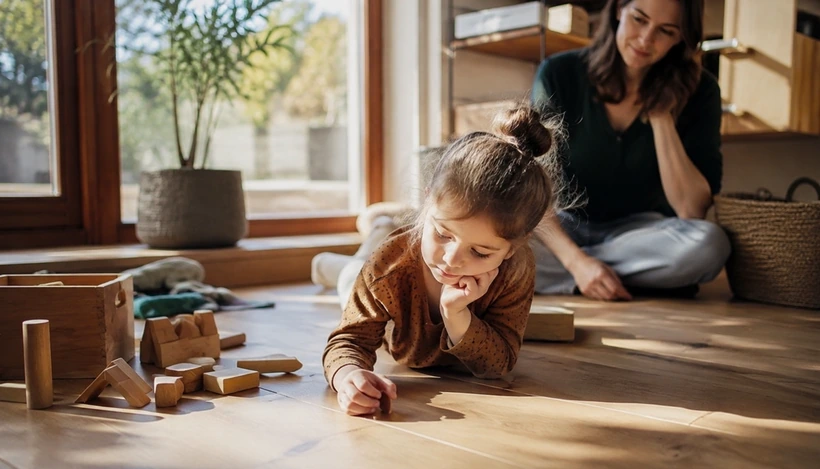
"Mom, I'm bored." For many parents, these three words trigger an instant reflex: hand over a phone or tablet, turn on a show, suggest an activity — anything to fill the silence. But what if that silence is exactly what your child's growing brain needs?
At kindergarten age, boredom isn't a problem to solve. It's an opportunity to protect.
The Brain Behind the Boredom
Between ages four and six, children's brains are undergoing some of the most intense development they will ever experience. Neural connections are forming at a remarkable rate, especially in the areas responsible for attention, imagination, emotional regulation, and problem-solving. This is the foundation-laying stage — the wiring that will support learning, focus, and creativity for years to come.
That wiring doesn't happen best under constant stimulation. It happens in the in-between moments — when a child stares out the window, fiddles with a toy with no "goal," or lies on the floor watching dust float in a sunbeam. These quiet, unstructured stretches give the brain space to process, make connections, and generate its own ideas rather than simply reacting to input.
What Screens Crowd Out
Screens aren't the enemy, but constant screen time changes what a young brain practices. Fast-cutting shows, bright colors, and instant rewards train a child to expect the next stimulus to arrive from outside. Over time, this can make ordinary, unstructured moments feel unbearable — not because something is wrong with the child, but because the muscle of self-generated attention hasn't had a chance to develop.
Minimizing screen time at this age isn't about deprivation. It's about protecting the space where a child learns to entertain their own mind — a skill that pays off for the rest of their life, in the classroom and far beyond it.
Let Them Be "Bored" — On Purpose
Try building small, regular stretches of unstructured time into your child's day: no screen, no adult-led activity, no instructions. Just space.
At first, this might be uncomfortable — for your child and for you. Resist the urge to immediately rescue them with a suggestion. Give it a few minutes. Often, what looks like restlessness turns into:
- Looking around — noticing a shadow on the wall, a bug on the windowsill, the pattern in a rug
- Observing — watching how water moves, how a sibling plays, how light changes in the room
- Wondering — asking questions that come from nowhere in particular
- Inventing — turning a cardboard box, a spoon, or nothing at all into a game
These moments are where curiosity is born. A child who has practiced sitting with "nothing to do" is a child who has practiced noticing the world — and noticing is the seed of every later skill in observation, science, and creative thinking.
The Power of Conversation Without Distraction
One of the richest replacements for screen time isn't another activity — it's you. Real, unhurried conversation with a present adult does something screens simply cannot: it responds.
A useful way to think about this is the cycle of pointing, naming, creating, and responding:
- Pointing — Your child points at something interesting. You look too.
- Naming — You put words to what's there: "That's a beetle. See how shiny its shell is?"
- Creating — Together, you build on it: a story about where the beetle is going, a guess about what it eats, a little song.
- Responding — Your child adds their own idea, and you respond to that, keeping the exchange alive.
This back-and-forth is something no screen offers, no matter how "interactive" it claims to be. A show delivers content at a child; a conversation grows with a child. Every round of this cycle strengthens language, attention, and the deeply human sense that their thoughts matter and someone is listening.
Try it during ordinary moments: a walk, a bath, folding laundry, waiting in line. No toys or props required — just your attention.
Rethinking "Good" Stimulation
It's tempting to believe that more input — more shows, more apps, more structured activities — means more development. But the evidence from child development points the other way. At this age, growth isn't driven by how much a child is entertained. It's driven by how much they get to create, explore, wonder, and connect.
A cardboard box becomes a spaceship. A pile of leaves becomes a treasure hunt. A quiet ten minutes on the porch becomes a chance to notice the way ants move in a line. None of this requires a screen — it requires time, and a little tolerance, from you, for the discomfort of "I'm bored."
A Few Practical Starting Points
- Build in unstructured windows — even 15–20 minutes a day with no screen and no set activity.
- Resist the rescue — when boredom hits, wait before offering a solution. Let your child sit with it first.
- Narrate the world together — point things out, name them, ask open questions, and really listen to the answers.
- Keep loose-ended materials around — blocks, boxes, fabric scraps, crayons, sticks and stones — things with no single "right" way to use them.
- Model it yourself — let your child occasionally see you sitting quietly, noticing something, without reaching for your phone.
Boredom isn't the opposite of a rich childhood. Often, it's the doorway to one. By protecting quiet, unstructured time — and filling the gaps not with screens but with real conversation — you're giving your kindergartener something screens can't replicate: the chance to build a mind that knows how to wonder on its own.