


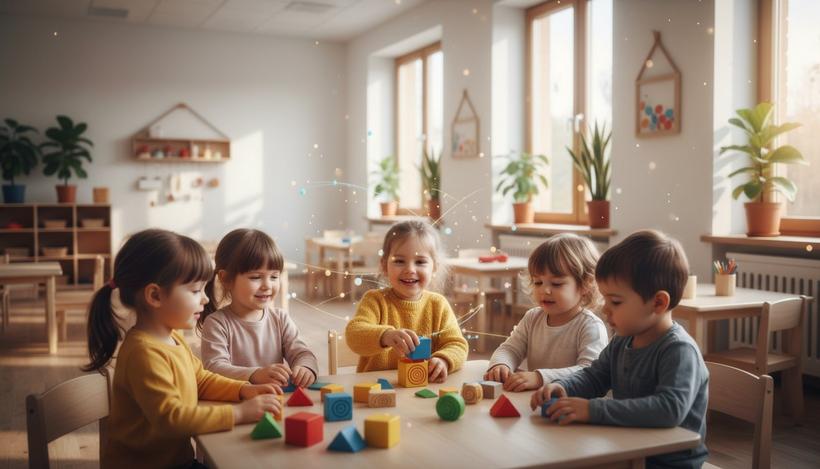
As a parent in our increasingly interconnected world, you naturally want to provide your child with every advantage for a bright future. The thought of introducing an foreign language in early childhood is exciting, yet it often comes with questions. Will it confuse them or delay their native Hungarian? Is it too much pressure for a preschooler? These are valid concerns that deserve clear, evidence-based answers. We believe the journey to bilingualism should be a joyful and enriching experience, one that builds confidence rather than causing stress.
In this article, we will explore the remarkable science behind early language acquisition, demystifying the process and showcasing the proven cognitive and social benefits that last a lifetime. You will gain the confidence that you are giving your child a significant gift-the ability to connect with the world. We will also provide essential guidance on how to choose a nurturing, effective international kindergarten in Budapest, ensuring your child’s bilingual journey starts in a loving, professional, and playful environment of excellence.
Key Takeaways
- Understand the "golden window" of early childhood when a child's brain is uniquely wired to absorb languages effortlessly.
- Discover how bilingualism provides a powerful cognitive workout, enhancing problem-solving skills, creativity, and mental flexibility.
- See how a play-based immersion environment makes learning a new foreign language a natural and joyful part of your child's daily routine.
- Get clear, evidence-based answers to common parental concerns to confidently support your child's bilingual journey in Budapest.
Why Start a Foreign Language in Kindergarten? The Brain's Golden Window
Parents often wonder about the perfect time to introduce a second language. While it's never too late to learn, neuroscience and child development studies point to a remarkable period in early childhood-a golden window when the brain is uniquely primed for language. Starting a foreign language, in kindergarten isn't about formal lessons or stressful exams; it's about harnessing a natural, innate ability to absorb language through joyful immersion and play in an environment of excellence.
The 'Window of Opportunity' for Language
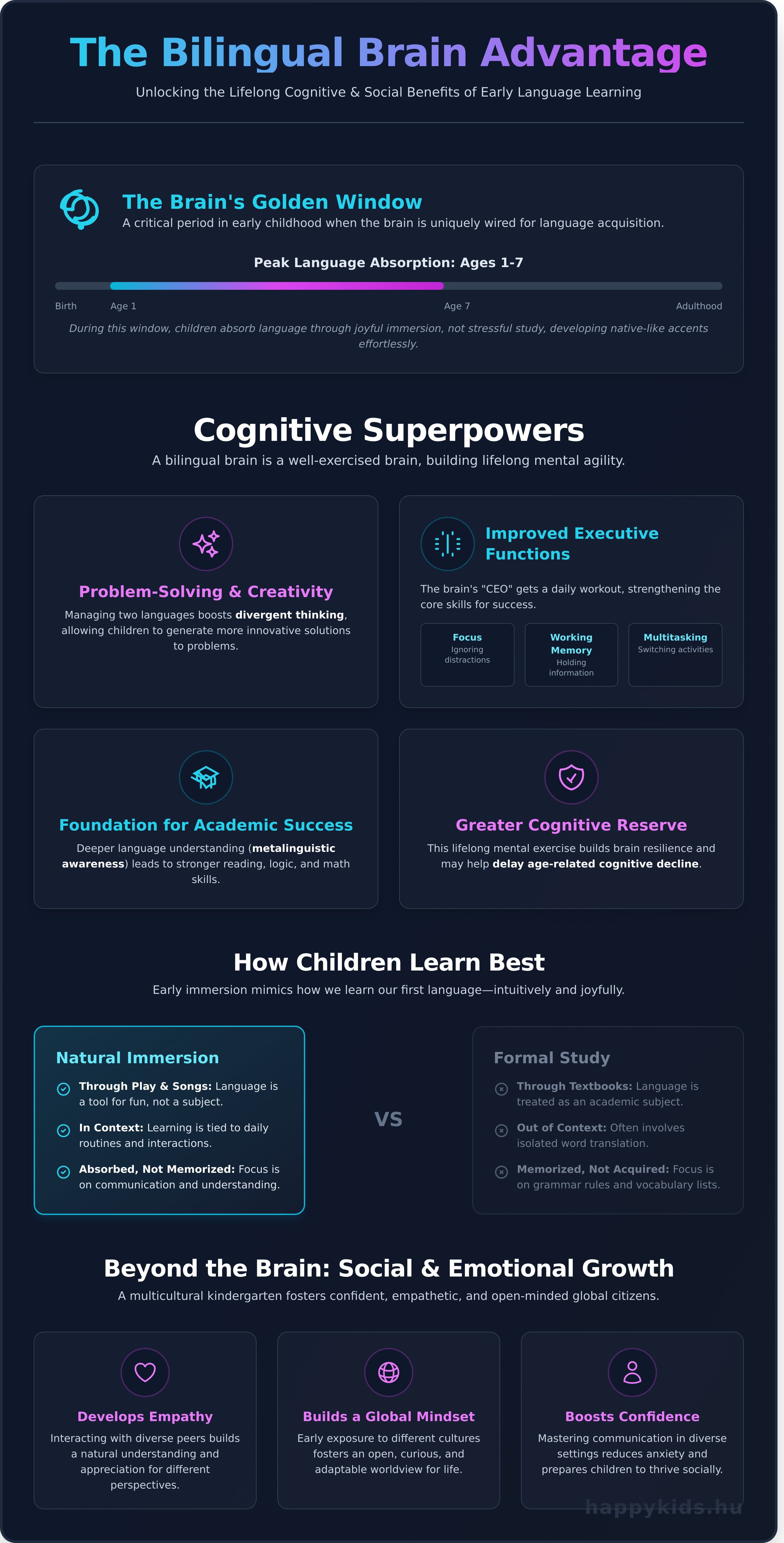
Between the ages of one and seven, a child's brain exhibits extraordinary plasticity, creating neural connections at an astonishing rate. During this critical period, children possess a superior ability to distinguish and reproduce phonemes-the subtle sounds that differentiate one language from another. This is why young learners can often develop a native-like accent effortlessly. Research confirms that this early exposure doesn't just teach a language; it builds a robust cognitive framework that supports all future learning.
Natural Acquisition vs. Formal Study
Think about how a child learns their mother tongue. It's not through textbooks but through context, songs, stories, and daily interactions. This is the essence of early immersion. Instead of memorising grammar rules, children acquire language as a living tool to express their needs, share their joy, and build friendships. This intuitive process, central to the science of Second-language acquisition, stands in stark contrast to the structured, often challenging, formal study many adults experience later in life.
Social and Emotional Growth in a Multilingual Setting
Learning a new language in a multicultural kindergarten offers profound social and emotional benefits. When children interact with peers and educators from diverse backgrounds, they naturally develop empathy and a global perspective. They learn to navigate different social cues and communication styles, building emotional intelligence and adaptability. This early experience in a caring, international setting fosters immense confidence, reducing communication anxiety and preparing them to thrive as open-minded global citizens in an interconnected world.
The Cognitive Superpowers of a Bilingual Brain
While fluent communication is a wonderful outcome, the benefits of early language immersion run much deeper, fundamentally reshaping a child's cognitive architecture. Think of a bilingual brain as one in a constant state of gentle, productive exercise. Every time your child speaks, listens, or even thinks, they are engaging two language systems, a process that builds mental agility and strength. This continuous workout endows them with cognitive ‘superpowers’ that provide a distinct advantage in all areas of life and learning, far beyond simply knowing an foreign language.
Enhanced Problem-Solving and Creativity
Bilingual children are masterful mental jugglers. This daily practice of managing two languages develops enhanced cognitive flexibility, allowing them to approach challenges from multiple perspectives with greater ease. Scientific studies show this constant mental switching boosts divergent thinking-the very engine of creativity. Instead of seeing one solution to a problem, they are more likely to generate a variety of innovative ideas, a skill that is invaluable in our complex, ever-changing world.
Improved Executive Functions: The Brain's CEO
Imagine your brain has a CEO responsible for managing everything you do. These are your "executive functions," and they are critical for success. This mental CEO directs skills like:
- Focus: The ability to concentrate and ignore distractions.
- Working Memory: Holding and manipulating information to complete tasks.
- Multitasking: Efficiently switching between different activities.
For a bilingual child, this CEO gets a powerful, daily workout. The brain must constantly select the appropriate language and inhibit the other, strengthening these core skills. Extensive research on the Cognitive Benefits of Bilingualism confirms these advantages. In the long term, this builds a greater "cognitive reserve," which studies suggest may even help delay the onset of age-related cognitive decline.
A Foundation for Academic Success
The cognitive skills honed by learning a second language translate directly into academic excellence. Bilingual children often develop stronger reading skills, as they have a deeper, more nuanced understanding of language structure (metalinguistic awareness). Grasping the grammar and syntax of an foreign language illuminates the patterns in their native tongue as well. Furthermore, the enhanced focus and problem-solving abilities cultivated through bilingualism are directly linked to better performance in logic-based subjects like mathematics and science, setting a firm foundation for a lifetime of successful learning.
How It Works in Practice: The Power of English Immersion
Many parents wonder how a young child can learn a new language so effortlessly. The answer lies not in traditional lessons, but in a carefully crafted, supportive environment where English is the air they breathe. This approach demystifies the process, making language acquisition a natural part of your child’s daily life. Let's explore what a day in a full immersion setting truly looks like.
What is Full Language Immersion?
Full immersion means that English is not just a subject to be studied; it is the language of instruction, interaction, and discovery for the entire day. This method mirrors the natural process of acquiring a mother tongue-through context, repetition, and meaningful communication in a loving, caring environment. It transforms the challenge of learning a foreign language into an intuitive and deeply integrated experience, where children live the language rather than simply memorizing it.
The Role of Play-Based Learning
In our environment of excellence, play is the primary engine for language development. Children are not sitting at desks with worksheets; they are absorbing English while engaged in joyful, purposeful activities that build social and cognitive skills simultaneously. This stress-free approach means learning happens naturally. A typical day is filled with opportunities for language use:
- Singing songs and reciting rhymes during circle time to learn rhythm and new words.
- Negotiating roles during imaginative play, saying "Can I be the doctor?" or "Let's build a big tower!"
- Listening to stories and asking questions, building comprehension and expressive skills.
- Creating art projects while describing colours, shapes, and textures with their teachers and friends.
Native-Speaking Teachers as Language Guides
The cornerstone of an authentic immersion program is its team of native-speaking teachers. They provide more than just correct grammar; they offer an authentic model of pronunciation, intonation, and the cultural nuances embedded within the language. Our educators act as nurturing guides, modelling rich vocabulary and complex sentences in a warm, encouraging manner. A high teacher-to-student ratio ensures every child receives personalized attention, fostering the confidence they need to experiment with and master a new foreign laguage.
By integrating language into every moment, from snack time conversations to outdoor exploration, we create a vibrant and effective learning tapestry. It’s a process built on connection, curiosity, and professional care. Explore Daily Life at Happy Kids to see how we create this joyful immersion experience for our children every day.
Addressing Common Parental Concerns and Myths
Embarking on the journey of bilingual education is an exciting prospect, but it's natural for parents to have questions. At Happy Kids, we believe in building a partnership based on trust and transparency. We welcome these discussions and are here to address some of the most common myths surrounding early language immersion with evidence-based insights, reassuring you that your child is in a supportive, expert-led environment.
Myth #1: 'Learning Two Languages Will Confuse My Child'
This is perhaps the most frequent concern, yet research shows the opposite is true. You may notice your child mixing words from both languages in a single sentence, a phenomenon known as code-switching. Far from being a sign of confusion, this is an indicator of high cognitive flexibility. A young child's brain is incredibly adept at building separate language systems, and code-switching is a natural, temporary phase of that sophisticated process. There is no scientific evidence to suggest any long-term confusion from early exposure to a new foreign language.
Myth #2: 'It Will Delay Their Mother Tongue Development'
While some bilingual children may initially have a slightly smaller vocabulary in each individual language compared to monolingual peers, their total vocabulary (across both languages) is often larger. A strong foundation in the mother tongue actually provides a crucial framework for acquiring a second language. The cognitive benefits gained through bilingualism-such as enhanced problem-solving, multitasking, and executive function-ultimately strengthen a child's command of all languages they speak, including their native one. The process of learning a new foreign language enriches, rather than hinders, their primary linguistic skills.
Myth #3: 'My Child is Too Young, It's Too Much Pressure'
It's vital to distinguish between academic pressure and natural acquisition. Our English immersion programme is built on a foundation of play-based learning. For a young child, singing a song in English, playing a game with an English-speaking teacher, or listening to a story is not a chore; it is a joyful exploration. We create a loving, caring, and homely environment where emotional well-being is the absolute priority. Our experienced educators are experts at integrating language organically into daily routines and play, ensuring the process is as natural and stress-free as breathing.
We invite you to learn more about our child-centric philosophy and see how we foster a love for learning in a multicultural setting of excellence.
Embrace the Power of a Bilingual Beginning
As we've explored, the early years present a golden window for language acquisition. By introducing a new language during this period, you're not just teaching words; you're building a more flexible, creative, and resilient brain. The decision to introduce a foreign language through natural, play-based immersion unlocks cognitive superpowers that will benefit your child for a lifetime, preparing them for a connected, global future.
Choosing the right setting is paramount to making this journey joyful and effective. At Happy Kids, we have created an 'environment of excellence' where this transformation happens every day. In our caring, multicultural community, home to over 20 nationalities, children learn English naturally through play. As chess grandmaster and proud parent Judit Polgár endorses, we provide a loving foundation for success. Give your child the gift of a world without borders.
Discover the multicultural environment of excellence at Happy Kids.
Frequently Asked Questions
What is the best age for a child to start learning a second language?
Research consistently shows that the optimal period for language acquisition is from birth to around age seven. During these early years, a child's brain is uniquely wired to absorb languages naturally and effortlessly. Introducing an foreign language like English during this "window of opportunity" allows children to develop pronunciation and grammatical structures intuitively, much like they learn their mother tongue. Starting in nursery or kindergarten provides a significant cognitive advantage for their future.
How long will it take for my child to become fluent in English at kindergarten?
While full academic fluency takes years, children in a full-immersion kindergarten programme typically develop strong conversational skills within one to two years. They will understand instructions, express their needs, sing songs, and interact confidently with peers and teachers in English. Our goal is to build a robust foundation and a love for the language in a joyful, play-based environment, setting them on a clear path towards lifelong bilingualism and effortless communication.
What is the difference between an 'international kindergarten' and a 'bilingual kindergarten'?
An international kindergarten, like Happy Kids, offers a truly multicultural experience where English is the primary language of instruction and community life, catering to families from diverse national backgrounds. A bilingual kindergarten typically focuses on developing proficiency in two specific languages, often Hungarian and English, with a more even split in language use. The international model provides a deeper, more constant immersion in the English language and a global cultural environment for your child.
How can we support our child's English language learning at home if we don't speak English?
Your support is invaluable, even without speaking the language. You can create a positive and encouraging atmosphere by playing English songs and audiobooks or watching age-appropriate English-language cartoons together. Celebrate their efforts and show interest when they share new English words or songs. The key is to make English a fun and normal part of their world, reinforcing the positive experiences they have at kindergarten without any pressure to perform.
Will my child develop a native-like accent?
Early and consistent exposure to native-speaking teachers is the most critical factor in developing a native-like accent. Children are exceptional at mimicking sounds, and when they learn in an immersive environment before the age of 6-7, they can acquire English phonemes without the accent of their mother tongue. While every child is different, early immersion provides the best possible opportunity to develop pronunciation that is clear, natural, and authentic.
What should I look for when choosing an international kindergarten in Budapest?
When selecting a premium international kindergarten in Budapest, prioritise institutions with qualified, native-English-speaking teachers and a low student-to-teacher ratio. Look for a secure, stimulating, and caring environment with excellent facilities. A strong, play-based educational philosophy, a diverse, multicultural community, and transparent communication with parents are also hallmarks of an institution committed to providing an environment of excellence for your child's development and well-being.